Rock and Roll
Make Your Own Moves
Vaux Mineral Collection
Tourmaline
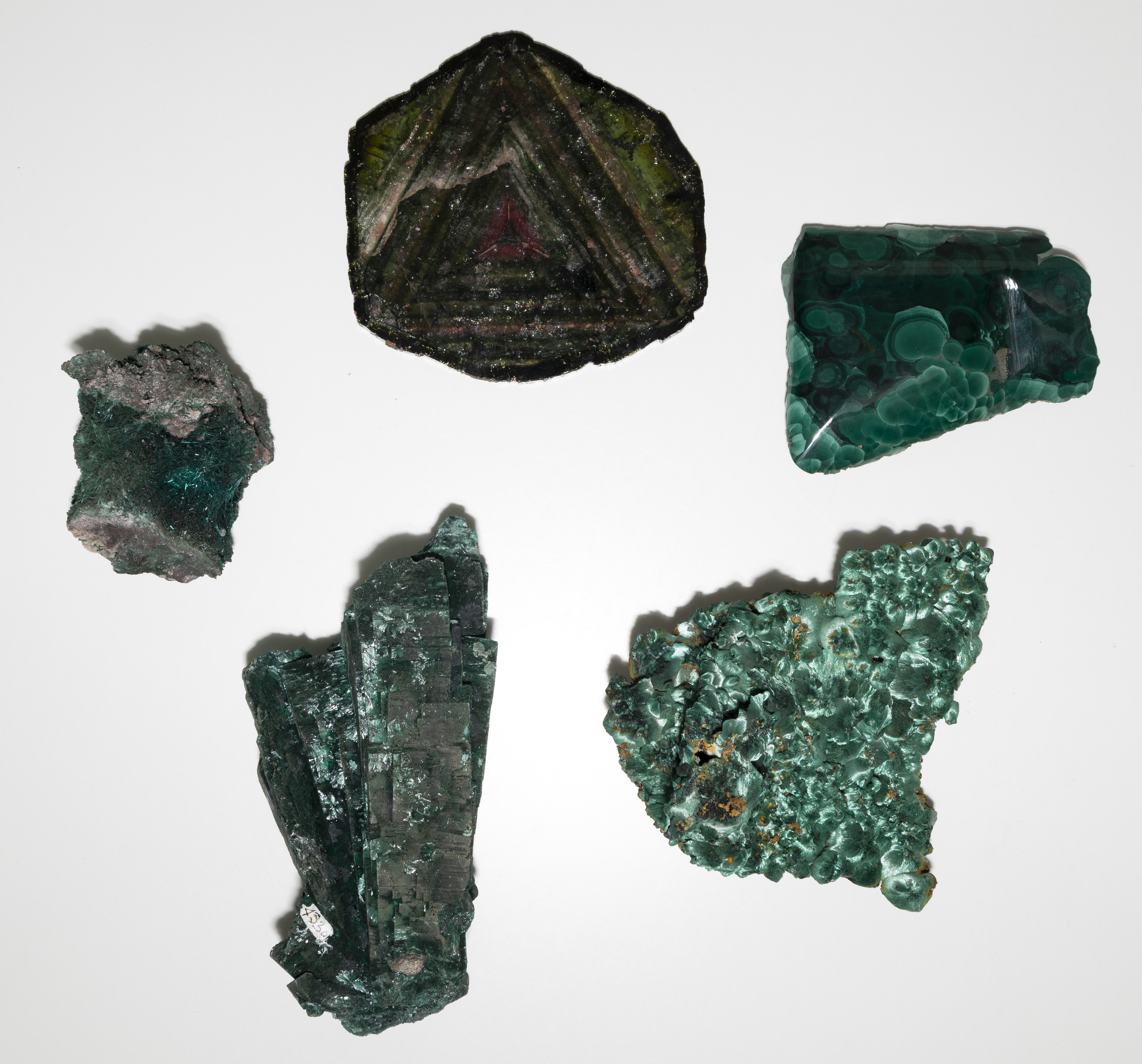
- Madagascar, Bryn Mawr Vaux Collection #6255
Malachite
- Polished, Bisbee, AZ, Bryn Mawr Vaux Collection #4312
- Velvet, Bisbee, AZ, acquired by George Vaux, Jr. in 1920, Bryn Mawr Vaux Collection #4311
- Acicular, Bisbee, AZ, Bryn Mawr Vaux Collection #4292
- Pseudomorphed after azurite, Tsumeb, Namibia, Bryn Mawr Vaux Collection #4330
These minerals formed through the movements of naturally occurring elements. The pink and green tourmaline is a cross-section of a larger crystal, formed as magma slowly cooled, depositing layers of crystal enriched in different color-causing elements, like manganese, lithium, sodium, iron, or calcium.
The bright green malachite, a byproduct of copper oxidation, comes in many different morphologies. Most malachite crystallizes and “grows,” moving steadily up and out from a central starting place. These specimens, mined in Arizona, are from the collection of George Vaux, Jr. (1863–1927, HC 1984). An enthusiastic amateur geologist, his diaries vividly describe the activities of hot springs, geysers, and other natural formations.
Collaborations between the Geology Department and Special Collections already underway aim to research the provenance of the College’s Rock and Mineral Collections, in order to better understand the historical power dynamics that shaped the mining and collecting of these specimens. Students can participate in this work next fall as part of a 360° course cluster, “Minerals, Museums, and Western Colonialism.”
Coins
Unknown Maker, probably Korean
Cowry Shell Coins, no date
Bronze
Gift of Helen Burwell Chapin (Class of 1914, AB 1915)
TN.164.a-b
Unknown maker
SEPTA Token
American, early 21st century
Metal
On loan from Carrie Robbins (MA 2009, PhD 2013)
Coins and tokens are traded every day around the world, helping people and objects move from one location to another. The bronze cowry coin, collected during Bryn Mawr alumna Helen Burwell Chapin’s extensive travels in China, Japan, and Korea, imitates natural shells which have symbolized power and prestige for hundreds of years. These coins circulated throughout east and southeast Asia, spread by trade routes and travelers, moving through countless sets of hands before arriving at Bryn Mawr. The SEPTA tokens are a currency specifically related to movement, or at least they were when these coins were used to ride Philadelphia’s buses and trains. Coins cross boundaries, carrying information about local markets and identities across communities.
Unknown maker
Reproduction Mycenaean Seal Ring, 20th century, after original of 15th century BCE
Brass
2009.4.141
Two horses race over the surface of this seal ring, pulling a chariot. The front figure in the chariot leans forward eagerly, drawing an arrow across his bow. The target, a frightened stag, looks back as it flees. The hunting scene is frozen mid-action like a candid snapshot.
This 20th-century brass replica captures a slice of aristocratic life from 1400 BCE Mycenae. The original ring would have been used as a stamp indicating ownership, authority, or personal responsibility in administrative and business transactions, pressed into clay documents to track the movement of products and records from one party to another.
Unknown maker
Zoetrope Drum, 19th century
Wood, metal, and paper
Gift of J. Philip Gibbs, Jr.
2007.18.1.a
This metal zoetrope drum may not look like much on the outside, but if you were to peer through its slits, the still images in the inner reel combine, like a modern GIF, into an illusion of repeating motion, bringing the scenes to life with each revolution.
Invented around 1833, zoetropes became popular as toys several decades later. Their reels show a wide range of activities, from dancing, to acrobatics, to swimming. They were made as light-hearted objects of play, but the imagery on some reels, including some of those in Bryn Mawr’s Collection, preserves antiquated and harmful biases.
Unknown maker
Babylonian Cylinder Seal, 1925-1700 BCE
Stone
Gift of Dorthea Chambey Blaisdell (Class of 1919) and Ann Blaisdell Irvine (Class of 1969)
S.111
On this small, stone cylinder, a seated figure raises one hand, acknowledging the smiling crescent moon that hovers above. But that’s only part of the picture. To discover the rest of the scene, you must roll the seal out onto a soft surface, like clay. Two more figures emerge, standing to the left, their edges blurred. On either side, vertical lines of cuneiform text frame the scene.
The picture probably depicts the presentation of worshippers to a god, a common scene for seals like this, which would’ve been rolled across clay to mark important transactions. Like the zoetrope, cylinder seals require motion to make their imagery fully visible.


This page has paths:
- A Guided Tour Yusi Liu